
Quick answer: what belongs in a Scale the Depths wiki?
A useful Scale the Depths wiki should not only repeat the basic loop. It should help players connect fish, scaling, upgrades, customers, map depth, and version choice so they can decide what to do next during a run.
The short version is this: track which fish you can catch reliably, which scaling action slows the table, which upgrade fixes that delay, and which customer requests are worth building around. Map progress and ending prep become easier once those four signals are stable.
This page is intentionally separate from the play page, download guide, and progression guide. The homepage owns instant browser play, the download page owns store and APK safety, and the guide owns step-by-step upgrade order. This wiki page is the reference hub for systems, terms, and source checks.
For players searching for a Scale the Depths map or all fish list, use the depth route as a planning tool rather than a fixed checklist. Each sea raises pressure on storage, equipment, fish value, and customer timing, so note what blocks progress before buying the next upgrade.
How to use this Scale the Depths wiki reference
Use this Scale the Depths wiki when you need a system-level answer rather than another general play summary. Start with the reference table, then use the fish, upgrades, customers, and locations sections to connect one decision to the next.
A practical example is a repeated customer request: check whether the fish is reliable at your current depth, whether scaling creates a queue, and whether the next upgrade fixes that bottleneck. Use the map guide for route timing and the progression guide for purchase order.
Example: a customer request Reliable fish plus a slow scaling station means an efficiency upgrade matters more than rushing to a new location.
Reference map for the main systems
Use this table as a quick index before reading the deeper sections. It keeps each search intent in its own lane so you do not confuse store questions with gameplay decisions.
| Topic | What to track | When it matters |
|---|---|---|
| Fish | Availability, value, preparation time, and whether a new fish slows the bench. | When a deeper area unlocks or a customer repeatedly asks for a specific catch. |
| Scaling | The action that turns raw catches into better sale value. | When fish pile up faster than you can prepare them. |
| Upgrades | Catch pace, tool speed, sale value, customer flow, and map access. | Before spending coins on an expensive upgrade that may not fix the current bottleneck. |
| Customers | Repeated requests, high-value preferences, and order pressure. | When coins lag even though fish are being prepared smoothly. |
| Map and ending | Depth access, location readiness, and whether the current loop can support new fish. | Before pushing into a new area or preparing for a final stretch. |
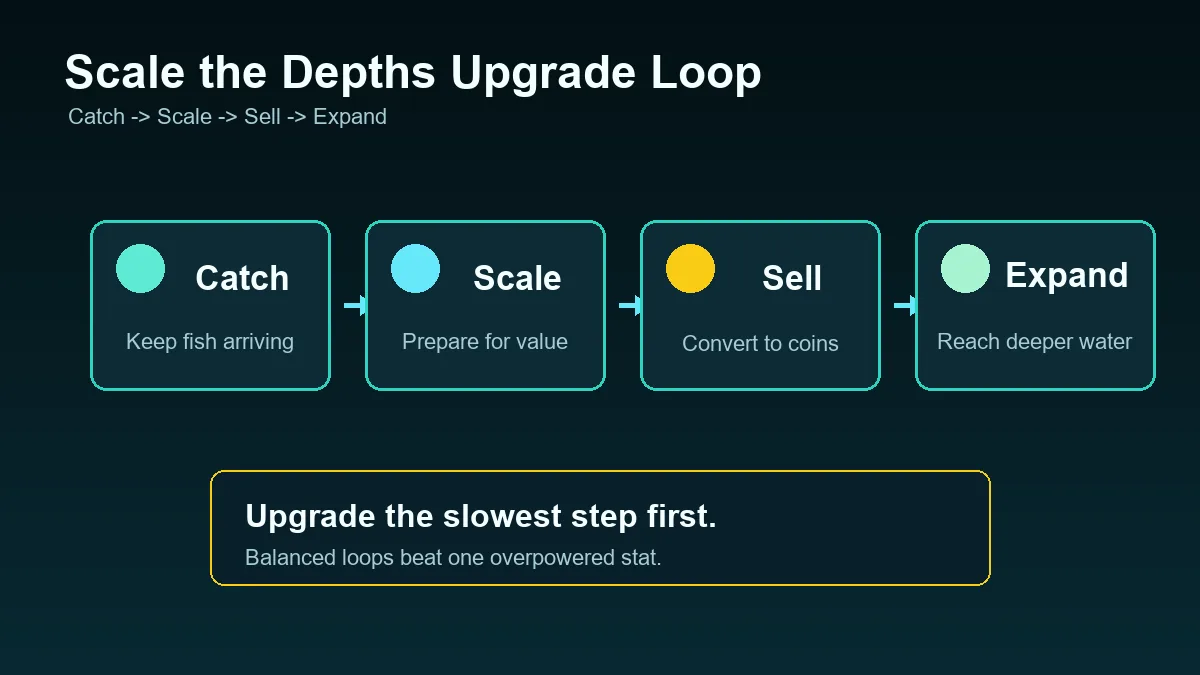
Fish reference: value is only useful when the loop stays smooth
Players often search for a Scale the Depths fish list because they want to know which catch is best. In practice, the best fish is the one your current tools can catch, scale, and sell without causing a long delay.
Track reliability first
A rare fish is not automatically better if it appears too slowly or forces the rest of the table to wait.
Compare preparation time
If a valuable fish takes much longer to scale, check whether the sale value still improves coins per minute.
Connect fish to customers
Repeated customer requests can make a mid-value fish more important than a rarer catch you cannot supply consistently.
Recheck after new depth
New locations can change the value order. Rebalance upgrades when a new fish tier appears.
Upgrades and customers: read the signal before buying
The best upgrade is usually the one that answers the clearest customer or workflow signal. Use the symptoms below to avoid spending coins on the wrong part of the system.
| System | Clue | Best response |
|---|---|---|
| Catch pace | You wait with an empty table. | Improve supply or depth access before buying more sale value. |
| Scaling tools | Fish are present but preparation lags. | Buy tool speed, automation, or friction-reducing upgrades. |
| Sale value | Prepared fish move smoothly but purchases still feel far away. | Prioritize value upgrades after the workflow is stable. |
| Customer flow | Requests repeat or pressure rises around one type of fish. | Build around reliable supply instead of chasing every request. |
Customer favorites and fish matching
Customer-focused searches such as Scale the Depths clientes wiki usually mean the player is no longer asking what the game is. They want to know how repeated requests, favorite fish, and location-specific demand should change upgrade choices.
Use customer signals as a planning layer, not as a separate objective. If a favorite fish is easy to supply, improve the tools that make that request faster. If the requested fish depends on a depth you cannot sustain, keep the older loop profitable before chasing the order.
| Customer signal | How to read it | Best wiki action |
|---|---|---|
| Repeated request for the same fish | The customer pattern is stable enough to plan around. | Prioritize reliable supply, scaling speed, and sale value for that fish instead of chasing every new catch. |
| High-value customer but slow supply | The reward is useful, but the current depth or catch pace is not ready. | Treat the request as a future-page detail and improve map readiness before optimizing around it. |
| Loch Ness or location-specific customer wording | The query belongs to the wiki/reference lane because the player needs a system lookup. | Use this page for the relationship between customers, fish, and depth; use the map guide for route timing. |
Map, locations, and ending prep
Map progress is best treated as a readiness check. A new location is worth pushing when catch supply, scaling speed, and sale value are already working together. If one of those systems is weak, deeper fish can reduce your effective income instead of improving it.
For ending prep, avoid thinking of the ending as one final purchase. A cleaner approach is to confirm that the current loop can handle higher-value fish, that customers do not stall sales, and that you can recover quickly after spending on a major unlock.
If you need exact download, platform, or version information, use official store pages. If you need a decision order for upgrades, use the progression guide. This wiki page should stay focused on reference relationships between systems.
Official and reliable sources
ScaleTheDepths.blog is an independent reference. For ownership, store availability, update notes, and browser build details, verify against first-party or store pages.
Steam
Use Steam for the managed PC listing, current store details, platform labels, and developer attribution.
Open Steamitch.io
Use the public itch.io page when checking the browser-playable build and creator page.
Open itch.ioProgression guide
Use the local guide for upgrade order, bottleneck diagnosis, map timing, and ending preparation.
Read guideFandom
Use the community wiki for item-style pages such as fish entries, but verify gameplay and version details against official sources when accuracy matters.
Open community wikiScale the Depths wiki FAQ
Is this an official Scale the Depths wiki?
No. This is an independent reference page that organizes gameplay concepts and links to official sources for store and version details.
What is the most important thing to track first?
Track the current bottleneck: empty catch supply, slow scaling, weak sale value, or customer pressure. That signal usually points to the next upgrade.
Does the wiki replace the progression guide?
No. Use this page for quick reference and system relationships. Use the progression guide when you want a more direct upgrade order and run plan.
Should I rush new map locations?
Only when your current loop is stable. New depth is useful when you can catch, scale, and sell the new fish without slowing the whole run.
Where should APK or download questions go?
Use the download guide and official store pages. This wiki page does not recommend unofficial APK, torrent, crack, or mirror downloads.
What is the first sea in Scale the Depths?
The opening sea is the learning area for the core loop: catch fish, understand their value, serve customers, and upgrade only when the next depth or demand exposes a clear bottleneck.