
Quick answer: when should you push the Scale the Depths map?
Push the Scale the Depths map when your current loop is stable: fish arrive regularly, scaling does not create a bench backlog, sales fund useful upgrades, and customers are not repeatedly blocking coin flow. If one of those signals is weak, a deeper area can slow your run instead of improving it.
The practical map rule is to treat each new depth as a readiness test, not a prize you must buy immediately. A new location usually brings better fish or stronger progression, but it also increases pressure on catch speed, preparation time, and sale rhythm. If your tools are behind, the new area exposes the weakness.
This page is separate from the broader progression guide because the search intent is narrower. Players looking for a Scale the Depths map usually want route timing, location readiness, and ending prep rather than a full beginner tutorial or download explanation.
Map decision example: when one unlock is not enough
If you can afford a new Scale the Depths map area only once, run one more cycle before buying it. Check supply, scaling speed, sale value, and customer flow together; a location is ready when the loop can pay for the tools that make it useful.
If one signal is still weak, spend on the bottleneck and return to the map after the next stable cycle. This keeps the map page focused on route timing while the Wiki handles system reference and the progression guide handles purchase order.
A simple readiness test Empty supply means catch or access first. A scaling queue means tool efficiency first. Stable flow plus recovery coins means the next depth is safer.
Scale the Depths map route overview
Exact names and balance can shift by version, but the route logic stays consistent: shallow progress teaches the loop, mid-depth tests tool balance, deeper areas test value and customer flow, and the final stretch tests whether your economy can recover after expensive unlocks.
| Map stage | Main goal | Ready when | Wait if |
|---|---|---|---|
| Shallow start | Keep the first catch, scale, sell, and upgrade loop moving without long waits. | You can buy small upgrades without saving for several slow cycles. | You still spend most of the run waiting for a fish or one manual action. |
| First expansion | Open the next depth only after catch supply and scaling speed feel balanced. | Fish do not pile up, and each sale visibly moves you toward the next purchase. | New catches would arrive faster than your tools can prepare them. |
| Deeper locations | Use higher-value fish without letting preparation time crush coins per minute. | You can process valuable fish while keeping customer flow steady. | One expensive fish makes the table stall or customers sit unresolved. |
| Ending prep | Balance supply, scaling, value, and recovery before spending on major unlocks. | A large purchase does not leave the run frozen for several minutes. | Your economy only works while holding coins and collapses after spending. |
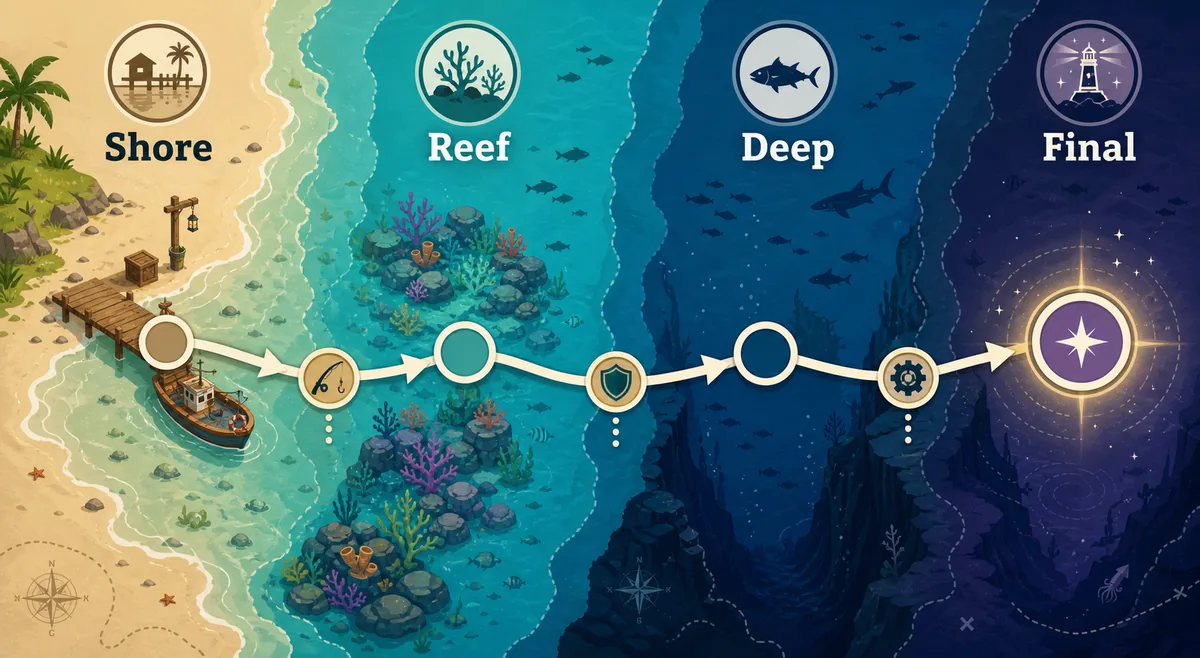
Four readiness checks before entering a new location
Before pushing the map, pause for one short cycle and diagnose the run. These checks prevent a new depth from becoming a coin sink.
Supply stays active
You should not stare at an empty table for long. If supply is weak, catch-rate or access upgrades matter before depth.
Scaling does not backlog
If fish are already waiting to be prepared, deeper fish will usually make the bottleneck worse.
Sales fund the next step
A new area is worth it when better fish make upgrades arrive faster, not when they only create one impressive sale.
Customers stay manageable
Repeated requests are useful signals. If you cannot serve common demand now, stabilize that loop before chasing the map.
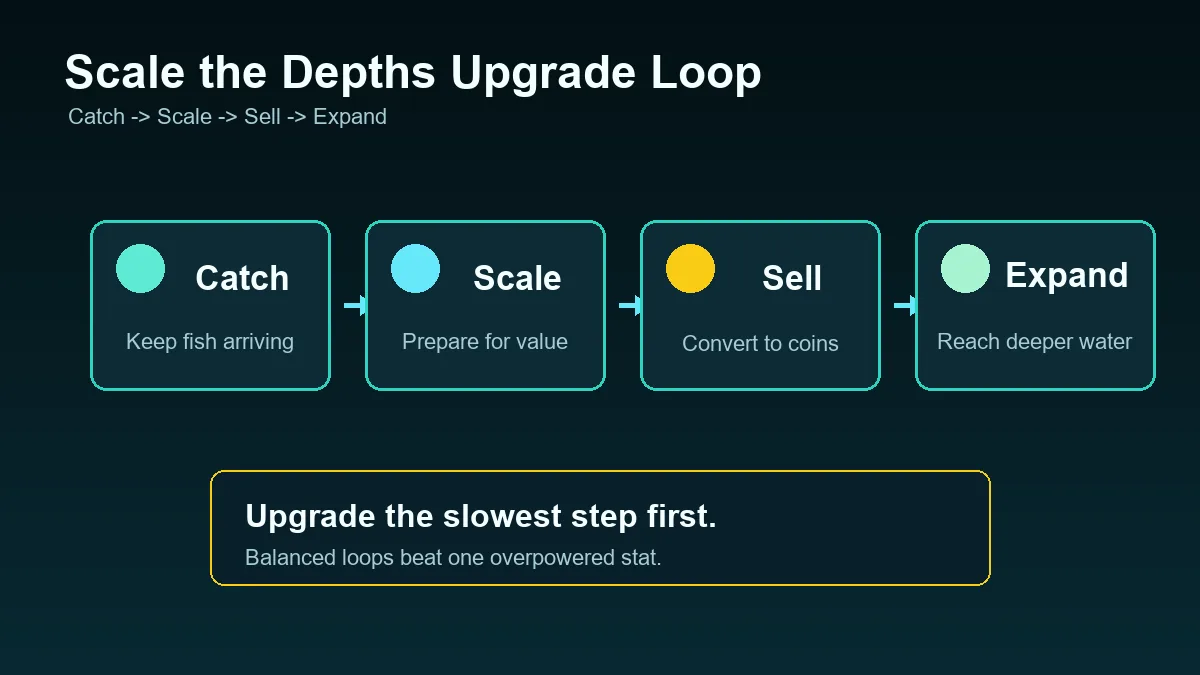
Practical stage plan for map progress
Use this plan when a new route, depth, or location feels tempting but your run is not obviously ready.
| Decision point | Best action | Why it works |
|---|---|---|
| You can afford the next depth once | Delay one cycle and buy a cheaper efficiency upgrade if the table still feels slow. | A single unlock is weaker than a loop that can profit from the unlock immediately. |
| New fish look more valuable | Compare full cycle speed, not only sale value. | A fish that sells high but blocks scaling can reduce real income. |
| Customers repeat one request | Build around reliable supply before exploring unrelated depth. | Demand signals often reveal the best short-term upgrade. |
| Ending prep starts to matter | Keep balanced recovery after major purchases. | The final stretch is easier when your economy restarts quickly after spending. |
Map mistakes that slow runs
- Rushing depth while scaling tools are already behind.
- Judging a location by one high sale instead of coins per minute.
- Ignoring customer favorites when they point to a reliable fish route.
- Spending on map access and leaving no coins for the upgrade that makes it useful.
- Treating ending prep as one final purchase instead of a balanced economy check.
- Using unofficial download or mirror pages as gameplay references instead of official store pages and stable guide sources.
Official and local sources
Use official pages for version details and local guides for route planning. This page does not recommend unofficial installers, torrents, APK mirrors, or copied download pages.
Steam
Check the Steam page for the current PC release, developer attribution, platform labels, and update context.
Open Steamitch.io
Use the public itch.io page when you want to test the browser build before deeper route planning.
Open itch.ioProgression guide
Use the progression guide for upgrade order and broader run planning beyond map timing.
Read guideScale the Depths map FAQ
Is there an official Scale the Depths map?
Use official store and developer pages for version-specific details. This page is an independent route-planning guide that explains how to decide when a new depth or location is worth pushing.
Should I unlock a new location as soon as I can afford it?
Not always. Unlock it when your current loop can support the new fish or customer pressure. If scaling, sales, or supply already lag, improve those first.
How do I know a deeper area is profitable?
Watch the whole cycle. If catch, scaling, selling, and customer flow stay smooth and upgrades arrive faster, the deeper area is helping.
Does the map guide replace the upgrade guide?
No. Use this page for location and depth timing. Use the progression guide for upgrade order, bottleneck diagnosis, and broader run strategy.
What should I do before ending prep?
Make sure the run can recover after a large purchase. Balanced supply, scaling speed, sale value, and customer flow matter more than one expensive unlock.